
Choosing ingredients for a nootropic pouch project
A nootropic concept becomes a manufacturing brief when the ingredient identities, extract standards, sensory requirements and intended positioning are defined.
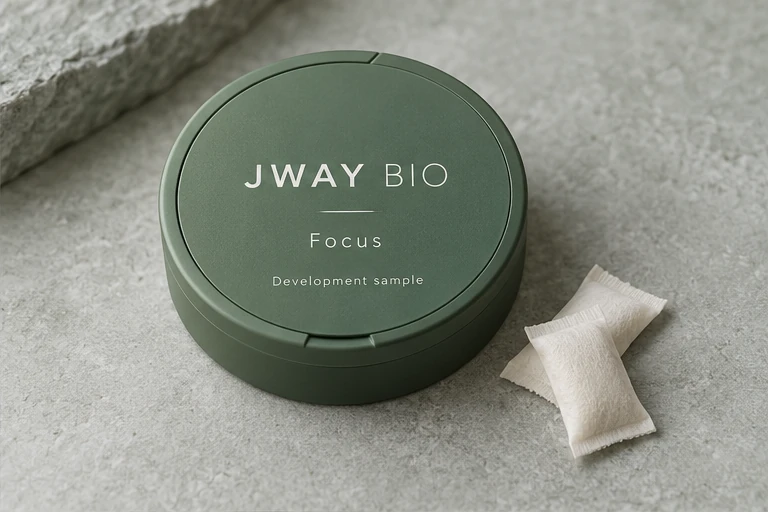
A nootropic concept becomes a manufacturing brief when the ingredient identities, extract standards, sensory requirements and intended positioning are defined.
Distinguish the product families
Focus, nootropic and mushroom programs can overlap in commercial language, but their briefs do not need to be identical. A focus project might start with L-theanine and other selected ingredients. A nootropic project might explore botanicals, while a mushroom project centers on species and extract choices. Use the product family to organize the discussion rather than assuming a particular combination is mandatory.
Specify the raw materials
Bacopa, ginseng, rhodiola and lion’s mane each require an ingredient specification. Common names can conceal differences in species, source material, extraction process, carrier and analytical markers. Ask the team which records are available and which details need confirmation for the proposed supplier. An ingredient selected for a previous project may not automatically meet the requirements of a new market or brand.
Check the pouch-format constraints
A compact pouch has finite payload and a distinctive sensory profile. Botanical and mushroom materials can contribute bitterness, earthiness or texture. Review the blend in the finished base and ask how the selected pack protects it. A large ingredient list is not inherently a better product; prioritizing a few defined ingredients can make the development questions clearer.
Keep evidence and wording connected
Ingredient popularity does not establish the effect of a finished pouch. Any proposed cognitive, mental-performance or wellness statement should be reviewed against the actual product evidence and destination-market rules. Avoid language about treating disease or guaranteeing a consumer outcome. Keep the technical ingredient description factual while the responsible adviser reviews commercial claims.
Record caffeine status explicitly
A nootropic name does not by itself mean caffeine-free. State whether caffeine is excluded, intentionally included or still open for discussion. Where a caffeine-free specification is required, agree what that means for ingredient sourcing, manufacturing controls and analytical evidence. The approved formula and specification should settle the question before artwork is finalized.
Questions buyers ask
Does a nootropic pouch need every ingredient in the source catalog?
No. The ingredient list is selected for the individual brief. Technical feasibility, market status, sensory requirements and supporting documentation guide the selection.
Can one ingredient’s research be used as proof for the whole pouch?
Ingredient-level information does not automatically establish a finished-product claim. Review the actual formula, available evidence and proposed wording separately.
Continue your project
Explore product programs · Review OEM / ODM services · Send your project brief
Make the guide useful for your project
Discuss the practical details.
Share your target market, product direction and the decisions you want to review.
Talk to the project teamAll buyer guidesQuality & documentsinfo@linkbiolabs.com